
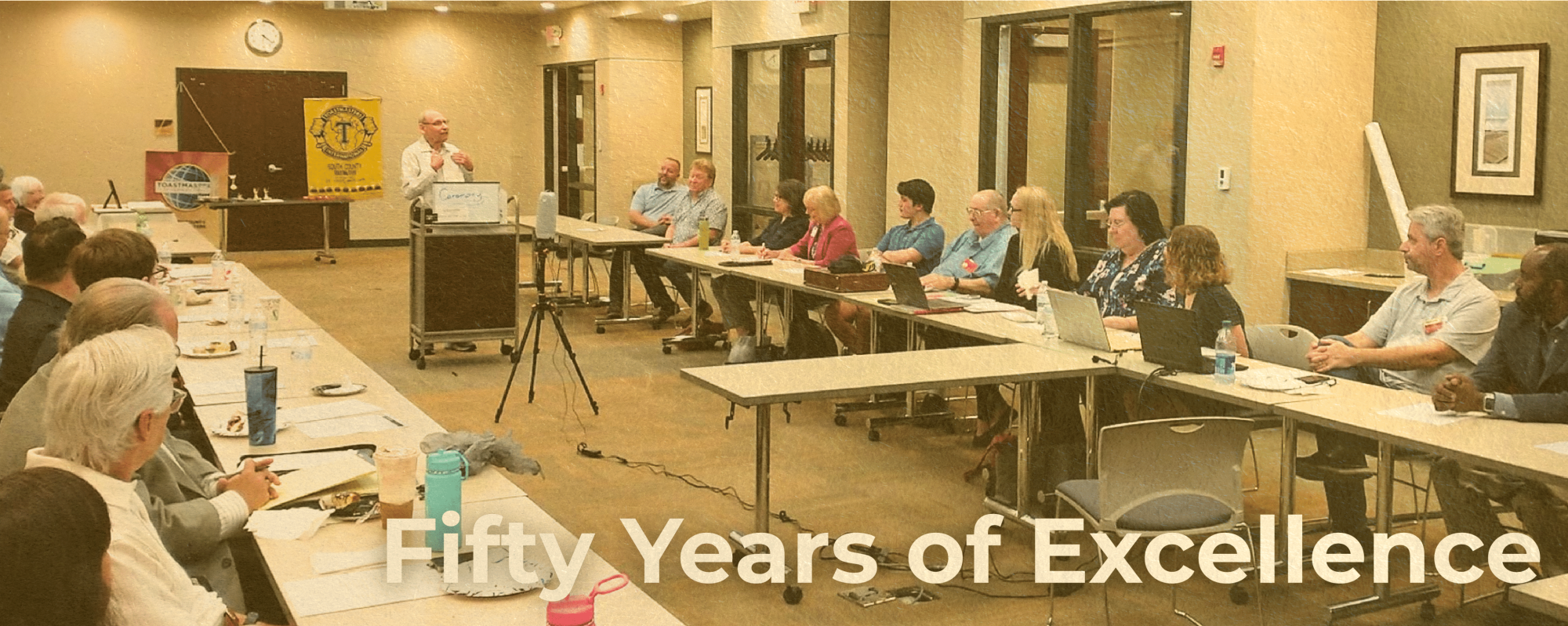
by Sue Dickemper
Below is the text of my speech.
BE A CHAMPION MENTOR
Miss Toastmaster, fellow Toastmasters and welcomed guests, before he became “the Great” Alexander of Macedonia was tutored by the Greek philosopher Aristotle. Jack Nicholson’s ability was polished by assistance from Martin Landau. Howard Brandt made Carl Hendrickson the Toastmaster he is today, and for which I am sure Carl has never forgiven Howard. Eddy Merckx, five-time Tour de France winner, mentored Lance Armstrong, seven-time Tour de France winner.
Consider if Lance Armstrong had not had a mentor, such as Eddy Merckx, Lance might never have gone on to be a seven time champion. Likewise, a Toastmaster mentor could mean the difference of a new member becoming a champion communicator and leader, or becoming a statistical dropout.
Just put yourself in a new member’s shoes for a moment – imagine being in a room full of strangers – perhaps you’ve spoken with a handful of them, casually – and they are doing strange things. You are called upon to speak but whenever you pause and use a filler word to help get your thoughts together, some mean person rings a bell. Another person over there is scrutinizing your grammar and will report you to the rest of the group if you happen to end a sentence with a preposition. And what about those lights? It looks like something from a NASCAR time trials.
An inexperienced member needs a good mentor. Tonight, I would like to give some specific examples of good mentoring in the areas of the Full Circle Award and the Competent Communicator Certificate.
First, the Full Circle Award. This award is, of course, the very prestigious award that a Toastmaster earns by fulfilling each of the 12 roles in a Toastmaster’s meeting. This distinguished award, which all Toastmasters should be seeking, was first earned by … no, not Howard Brandt, no not Carl Hendrickson, no not outgoing President Rich Ullrich, but by yours truly.
So my protégé has been assigned his or her first role, and I’ll use the example of “Ah Counter”. I will explain to him or her, prior to the meeting, all that is required of this role. By way of a telephone call, email, or meeting in person with my mentee , or a combination of these things, I ensure that she or he knows ahead of time all of the tasks expected of this role and how to perform the duties of the Ah Counter. As mentor, I will sit with him or her during the meeting to give direction and answer questions. If I am not able to attend a meeting, I shall make sure that another experienced Toastmaster will sit with my protégé and assist him or her during the meeting. I‘ll also explain that when the Toastmaster introduces the Ah Counter, he or she will stand up and address the room, and, mostly for the purposes of any guests in attendance, describe what is the function of the Ah Counter. When he or she hears a crutch word from a speaker other than a prepared speaker, he or she will ring the bell. I tell my mentee, “you will need a pen and blank piece of paper in order to take notes as you listen and hear crutch words. This is so you can stand and give an oral report as the General Evaluator calls upon you during the evaluation part of the meeting.”
For Grammarian, Time Keeper , Vote Counter, I would provide the same type of detail instructions and support. In addition, but not instead of, I can, refer my protégé to the back of the Competent Communicator Manual where all of the roles with the duties are described.
As my protégé is assigned other roles for the first time – evaluator, table topics, general evaluator, toastmaster – I explain that these roles each require various degrees of preliminary preparation. As an example, for the evaluator role, I tell my protégé that there are some excellent resources on our SCTM website that could help in preparation of this role and I will direct him to those. When my mentee is Table Topics Master for the first time, I will explain that he or she needs to find out from the Toastmaster if is there a theme for the evening. Also confirm with the Toastmaster who has assigned speaking roles so you don’t call on them for Table Topics. As for the General Evaluator role, I share with her or him that it is helpful to complete an agenda for your portion of the meeting for your own personal use to help keep track of time, and the order of events.
I will contact my mentee when I see that he or she is going to be jokemaster and ask, “hey, have you been able to put some material together?” I will let the new jokemaster know that one needs to be flexible as far as the amount of material since time at the lecturn will depend upon how long the vote counter takes to tally the last votes and write out the awards of the evening. I share the hint with him that when you see the vote counter pass off the awards to the Toastmaster, that’s your clue that it’s time to wrap things up. Personally, I can vouch for that one, because I remember the first time I was jokemaster, I didn’t know when to stop! As Carl, the Toastmaster that evening, was standing by my side with awards in hand, I kept going and on with my jokes. . Knowing that Carl is a politician, I assumed that he wanted more time to talk, and I had some really good material. Carl was about to take a hook and drag me away from the lecturn.
Another goal with which a mentor helps a new Toastmaster is the attaining of the Competent Communication Certificate. New members need help preparing and rehearsing their speeches, especially the first few. Just reading through the manual of the 10 required speeches can be overwhelming to a new speaker! I remember! Be sure they understand that the speeches do not have to be done in the same order as in the Competent Communicator Manual. Offer to meet so that your mentee can practice his or her speech with you. Naturally, you would want to give positive feedback as well as suggestions for improvement on the content and delivery.
In summary, as a mentor, I would make myself available to my mentee for every meeting he or she attends, every role filled, and every speech given. I won’t assume that if I don’t hear from him or her, that there aren’t any questions. I must take the initiative to make personal contact.
My objective tonight was to instill in each one of us the importance of our commitment as a mentor to the new member, and how to fulfill that commitment on a practical level. It’s a win-win situation. The new member appreciates and benefits from our support. And as a mentor, we learn new skills ourselves, we’re doing something for others, and we are investing in the future of South County Toastmasters.
Miss Toastmaster, fellow Toastmasters, the task of being a Coach is not an easy one. But if you perform the duties and responsibilities of a Champion Coach, you shall take great pride in seeing your protégé earn the Full Circle Award and obtain the Competent Communication Certificate.
 southcountytoastmasters.org